Since 2008, our customers have created over a thousand jobs
through improved paint finishing, opened new facilities, expanded existing
ones, and brought hundreds of millions in production
to the USA.
Improved paint finishing operations have added greater
than a billion dollar value to their businesses. The average
NAPaint project ROI is less than 5 months. Annual
benefit can exceed tens of millions.
Maximizing
Throughput
Throughput
refers to the quantity of parts processed by a paint system in a
given time. By consistently and reliably maximizing
throughput, the cost per part decreases while the quantity of
finished goods increases. Such a combination allows
businesses to be managed with more flexibility and profit. Many aspects of a paint application system
affect, limit, or control the level of throughput that is
obtainable from a paintshop.
North
American Paint Applications is the world leader in the implementation
of methods for increasing throughput for every type of paint application. When
we say improve throughput, we mean it. We look forward to
spending a few days in your paintshop reviewing the possibilities
with you.
Part
rack design
that maximizes system performance and part window utilization
coupled with efficient
automation
are critical for achieving maximum productivity and system
performance.
High
end SUV rear spoilers base / clear application. Quality finishing
with high throughput and yields can often be significantly more
profitable than lower throughput with higher transfer efficiency.
Less
than 4 seconds per spoiler!
Part
Density and Rack Design
Poor
part rack design can cut throughput in half, or more. Poor
part rack design can significantly increase the number of defects
in the finished product, reducing yields by 50%. Poor part
rack design alone can reduce the overall productivity of your
system by two-thirds.
It
is difficult to visualize how you might achieve 8 parts on a rack
rather than 4 without a thorough understanding of the process and
operational limitations of your system. Robot reach and
wrist orientation, applicator type and capability, flash times,
and paint properties are some important considerations. You
don't know what you don't know, and it could be costing you big.
Rack
design can also affect reliable part grounding, fire safety, and
consistency.
Paint
Robot Process Programming and Integration
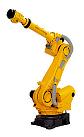
There is much
that can be done in the programming and set-up of the paint robot to
increase throughput. Once you have
a suitable part carrier, a well designed robot program will increase throughput, quality, and yields dramatically.
Our programmers implement continuous spray path throughout the job cycle maximizes
painting time. Triggering
paint off the part or triggering when no part is present, improper head to target
distances, improper
angles of application, jerky motion, excessive mechanical force in abrupt turn around
points, excessive atomization, and large spray patterns are a few of the control variables that profoundly affect the
operational efficiency of
automated systems. Achieving automation only finishing can
increase throughput, yields, and quality.
A
robot fault, for any reason, can often severely impact both
up-time and first time yields. An efficient paint robot programmer will prevent robot faults associated with
any movements, singularities, line stops, limits, or applicator operation
. Our programmers avoid over rotated and contorted
wrist movements that damage applicator tubing and cables. Turbine flooding, paint spits,
excessive paint build-up, HV faults, color mismatch, lights and
heavies, poor color changes, and crashes are all preventable with
efficient programming and integration.
When
two or more robots paint the same target, with perhaps door
openers incorporated, a well conceived and orchestrated
application program can have a dramatic impact on throughput.
Paint
Supply
An
adequate and reliable paint supply is essential to maximizing
throughput. A paint shop may utilize a conveyor with the
most accurate speed control; it may have installed extremely
reliable
robot mounted applicators; but if paint cannot be accurately
dispensed, then the high
performance of the conveyor and robot applicators, dearly bought,
may equate to money spent without return. Inconsistent
paint supply can contribute to increased requirements for manual
spray.
Stopping conveyors
or idling equipment to change colors, cans, drums, or totes can
have a tremendous impact on equipment utilization and throughput.
Applicators
Many
types and sizes of applicators are available for applying your
material including rotary atomizers, conventional air spray, high
volume low pressure (HVLP), air assisted and airless, both in
electrostatic and non-electrostatic types. Utilizing the
right applicator for your process ensures that production and
quality levels can be met.
Equipment
Limitations
The
proper specification and application of equipment is essential to
obtain maximum throughput. Often, exchanging one or two
restrictive components with properly specified replacements can
have a tremendous impact on throughput. NAPA can provide an
experts perspective to identify all such opportunities in your
paint shop.
Conveyor
Speed and Utilization
The
speed of the conveyor can be limited by any phase of the paint
application process including load, pre-treatment, paint
application, curing, unload, or for
quality reasons. It most facilities, conveyor speed ought to be limited
by the existing curing and oven infrastructure. If it is
limited for any other reason, North American Paint Applications
can probably help you speed it up to increase throughput.
Power
and free conveyors are often poorly synchronized with automation,
causing avoidable delays in every job space.
Conveyor
utilization refers to the percent of the conveyor, in a given time, that produces product. This includes
conveyor stoppage. Product gaps on the conveyor are often
purposely left for changing colors and for other reasons.
Robots can sit idle as a result. Manual sprayers can stop
the line. Sometimes, entire conveyors are stripped of product at the end of
each day. Often, regular manual tasks require the conveyor
to be stopped. Whatever the reason, any time the conveyor is
empty or stopped, nothing is produced.
North American Paint Applications
can provide a thorough analysis of your
entire process to outline methods for improving conveyor
utilization.
Pre-Treatment
Most
parts require some sort of processing prior to painting.
Cleaning, phosphating, rinsing, electo-coating, drying, wiping,
dusting, blowing, ADPro, and flaming
are a few common pre-treatments. These systems ought
to be designed to perform efficiently, repeatably, and with
sufficient flexibility. Problems
such as inadequate cleaning, poor phosphating, spotty
electro-coating, or water marks should never occur when suitable
equipment is functioning as designed. Dirt on parts is
possibly an indication of contamination from pre-treatment
systems.
Cure
The
existing curing and oven infrastructure, and controls, are often
the determining factor for limiting throughput through the paint
process. NAPaint can analyze your curing process and quickly
determine whether or not it is achieving the highest levels of
throughput.
Quality
Maintaining
high quality standards of the finished product can significantly
affect throughput. For example, a speed up in conveyor may
result in uneven film distribution across the part. Reducing
gaps in the conveyor may result in overspray contamination.
An increase in flow rate from the applicator may result in solvent
pop or blistering during curing. Paint processes have an
endless list of cause and affect that must be carefully considered
when maximizing throughput and line yields.
Feel
free to give
me a call to discuss . . . Joe @ (708) 980-3758.