|
Since 2008, our customers have created over a thousand jobs
through improved paint finishing, opened new facilities, expanded existing
ones, and brought hundreds of millions in production
to the USA.
Improved paint finishing operations have added greater
than a billion dollar value to their businesses. The average
NAPaint project ROI is less than 5 months. Annual
benefit can exceed tens of millions. |
|
Color
Change
A
color change is the purging of one color from the paint applicator and
the loading of a second color. Sometimes, it includes a paint push
out. Color changes affect quality, throughput, waste, and
maintenance and can have a severe impact on the overall productivity of paint
processes. Whether you have a manual color change or an automatic
color change, you may find the discussion below useful to both operator
and maintenance personnel and as an aid to management in making the
right decisions .
North
American Paint Applications is the world leader in implementation of
efficient color changes for every type of application.
Duration
When
changing colors, the equipment is not painting. It follows then
that the longer the duration to complete the color change process, the
lower the part throughput of the system. Long color changes often
have a negative impact on productivity.
As
an estimate in automated systems, typical color change times are one
second per foot of paint hose from the color valve stack to the
applicator. Manual systems vary widely. With efficient
design, faster color change times can be easily achieved. An
integrated color change and cap clean that begins at the last trigger
off can save 5 to 10 seconds of cycle time.
Repeatability
Automated
color changes ought to be designed to purge and load the lines
efficiently, repeatably, and with sufficient flexibility to make
allowances for all purging and loading variations among the different
materials. For example, it is common that white may be more
difficult to purge than black and may take longer to load. The
system ought to be flexible enough to support this.
Problems
such as color carryover, insufficient paint load, sputtering, and
overspray contamination should never occur when equipment is functioning
as designed. The system should be repeatable for any
combination.
Waste
Unless
a paint push out is incorporated, all material used during a color
change is waste and must be disposed of. In automatic color
changes, it is normally collected via piping direct to waste
storage. Only a minimal amount of waste material required to clean
the bell or gun is normally sprayed into the booth.
The
amount of material used for color change depends on many factors,
including paint line length and size, paint and solvent chemistry,
equipment, and method of implementation. Paint is the most
expensive material of the waste and the amount used should never be
greater than 120% of the internal volume of the piping system from the
color valve stack to the applicator, and less if a paint push out is
used. For solvent, a good benchmark would be less than one cup per
5 feet of paint line.
Paint
Push Out
Paint
push out refers to the process of 'pushing' paint out of the lines and
onto the part prior to a color change. This is usually done with
solvent. In this way, less paint is wasted during a color change
and color change times are shortened.
Manual
vs. Automatic Color Changing
Many
facilities depend upon labor to implement a color change. While
this may seem most economical at first glance, there is a real cost
associated with manual color changes that must be accounted for.
First,
manual color changes usually take significantly longer than automated
color changes. If the conveyor must be stopped or gaps inserted to
facilitate the change, throughput suffers.
Second,
the operating cost of manual color changes is much higher than automatic
color changes. This results from increased labor costs, increased
material costs, and increased waste handling and disposal.
Third,
the quality of the color change is not certain to be repeated.
NA
Paint is ready not only to automate your color change, but to optimize
it. A cost/benefit analysis must be performed, but it is our
experience that in most applications automating will save large amounts
of paint and solvent, emissions, reduce booth contamination and filter
loading/sludge creation, improve quality and consistency, and increase
paint shop throughput significantly. We look forward to helping
you analyze your existing process.
Feel
free to give
me a call to discuss . . . Joe @ (708) 980-3758.
Some Platforms Supported
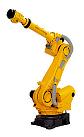
Fanuc Paint Mate 200iA - Dispensing, Painting Automation.
R30iA Controller
Fanuc Paint Mate 200iA/5L - Dispensing, Painting, Coating Automation.
R-30iA Controller
Fanuc P-10, Fanuc P10 � Door Opener, Painting Automation.
Fanuc P-15, Fanuc P15 � Hood/Deck Opener, Painting Automation.
Fanuc P-50, Fanuc P50, Fanuc P-50i, Fanuc
P50i - Bonding, Sealing. Painting Automation. RJ3 Controller
Fanuc P-50iA, Fanuc P50iA, Fanuc P-50
iA - Dispensing, Painting, Coating Automation. RJ3iB Controller
Fanuc P-100, Fanuc P100 - Dispensing, Painting, Coat Automation.
RJ Controller or RJ2 Controller
Fanuc P-120, Fanuc P120 � Material Handling.
R-J2 Controller or R-J3 Controller
Fanuc P-145, Fanuc P145 - Dispensing, Painting Automation. RJ2 Controller, RJ3 Controller, or
R-J3iB Controller
Fanuc P-155, Fanuc P155 - Bonding, Sealing, Dispensing, Painting Automation.
R-J Controller or RJ2 Controller
Fanuc P-200, Fanuc P200 - Bonder, Sealer. RJ2 Controller or RJ3 Controller
Fanuc P-200E, Fanuc P200E - Dispensing, Painting Automation. RJ3iB Controller
Fanuc P-200T, Fanuc P200T - Bonder, Sealer,
Cleanroom, Dispensing. RJ2 Controller or RJ3 Controller
Fanuc P-250iA, Fanuc P250iA, P250 -
Cleanroom, Dispensing, Paint Automation. RJ3iC Controller
Fanuc P-250iA/10S, Fanuc P250iA/10S - Dispensing, Paint Automation. RJ3iC Controller
Fanuc P-250iA/15, Fanuc P250iA/15 - Bonding, Sealing, Dispensing, Paint Automation. RJ3iC Controller
Fanuc P-250iA/15T, Fanuc P250iA/15T - Bonder, Sealer, Dispensing, Paint Automation. RJ3iA Controller
Fanuc P-500, Fanuc P500, P-500iA, P500iA - Paint Automation. RJ3iB Controller
AccuFlow,
AccuChop, AccuAir, AccuStat, Integral Pump Control ICP, ServoBell
and SpeedDock.PaintTool, PaintPRO, RoboGuide, PaintWorks, WinTPE.
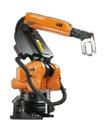
ABB Tralfa TR-5000,
ME5002,
ME-502,
TR5000,
5002,
ME502 - Paint Robot. C5.3
Controller or C5.3B Controller.
ABB IRB 540, ABB IRB540, ABB IRB 540-12, ABB
IRB540-12 - Paint Robot. S4P, S4P Plus, or IRC5P
Controller.
ABB IRB 580, ABB IRB580 - Painting Robot. S4P
Controller, S4P+ Controller, S4C, or IRC5 P Controller.
ABB IRB 52, ABB IRB52 - Painting Robot. IRC 5P
Controller.
ABB IRB 5300,
IRB5300 - Door Opener. S4C Controller.
ABB IRB 5400, ABB IRB5400 - Painting Robot. S4P, S4P+, S4C, or IRC5P
Controller.
ABB IRB 5400-02, ABB IRB5400-02, ABB IRB 5400-03,
ABB IRB5400-03 - S4P, S4P Plus, or IRC5P Controller.
ABB
IRB 5400-04, ABB IRB 5400-04, ABB IRB 5400-12, ABB
IRB5400-12 - S4P, S4P Plus, or IRC5P Controller.
ABB
IRB 5400-22, ABB IRB5400-22, ABB IRB 5400-24, ABB
IRB5400-24 - S4P, S4P Plus, or IRC5P Controller.
ABB IRB 5402, ABB IRB5402 - Paint Robot. S4P or S4P Plus
Controller.
ABB IRB 5403, ABB IRB5403 - Paint Robot. S4P or S4P Plus
Controller.
ABB IRB 5500, ABB IRB5500 � Paint Robot. IRC5P
Controller.
RAPID,
RobView, Integrated Process System IPS, RobotStudio, simulation.
Sames
TRP 500,
TRP500, TRP-501, TRP501, TRP-502, TRP502, TRP-DP,
TRPDP,
single and dual head/purge spray gun, PPH 707 SB
bell, EC 35, EC 50, EX 65 Hi-TE, Range 7
Fiber Optic Bell Speed Control, BSC 100, BSC100, BSC 605, GN
3002 (GN3002) GN 4002 (GN4002), GN 5002
(GN5002), PPH707 test stand, etc.
EFC
ES19NE, FS40R, EFC Mini Gun, EFC 100, UP
200 High Voltage Power Supply, etc.
ITW
Ransburg RMA 202, RMA 303 Direct Charge Rotary Atomizer, RMA202, RMA303
Indirect Charge, Aerobell 33, Aerobell33, Evolver, Evolver SE, AGMD, REA 90,
REA90, REA 900A, REA 9000W, AquaBlock, AquaTank, TurboDisk, AdaptaFlow,
DynaFlow, RCS Gear Pump, RansFlow, PulseTrack, Etc.
Graco ProMix, Pro Mix 2KS, 3KS, 2KE, PrecisionMix, PMix, P-Mix, Precision Mix II.
Control
Platforms Allen Bradley PLC-3, PLC-5, SLC-500, PLC3, PLC5, SLC500,
MicroLogix
1000-1100-1200-140-1500, CompactLogix 1768/1769, Controllogix
5000/1756, Schneider Modicon Quantum, Modicon Premium, Modicon
M340, Momentum, Mitsubishi L Series MELSEC L, Q Sereis, Siemans
SIMATIC S7 200-300-400-1200, Siemans LOGO, AutomationDirect
Productivity3000, DirectLogic, CLICK, AC500, AC 500, OMRON
NSJ-CJ2-CS1-C200HX-C200HG-C200HE-CS-CJ1-CJ1G-CP1-CVM1/CV, TCP/IP,
Ethernet IP, Data Highway, DeviceNet, ControlNet, Profibus, Modbus,
CC-Link, Genius, Remote IO, WonderWare, Visual Basic, C++, RS
Logix, RS View, FactoryTalk, ConCept, ProWorx 32, ProWorx32, etc.
|
|
|