Since
2008, our customers have created over a thousand jobs in
paint finishing, opened new facilities, expanded existing
ones, and brought millions in production back to the USA.
Improved paint finishing operations have added greater
than $600 million to their businesses. The average
NAPaint project ROI is less than 5 months. Annual
benefit can exceed tens of millions.
THE
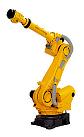
PAINTING ROBOT
Painting
robots have a tremendous impact on the efficiency of paint
application processes. But like any tool, it is only as
efficient as the person using it. Robots helpful
characteristics are strength, speed, accuracy, flexibility, repeatability, and endurance. If the owner can utilize these
advantages in an efficient method
of paint application, his or her system can often be more
productive and economical than
other types of paint application.
But
the sheer complexity of paint robot automation can confound even
the brightest and most experienced installers, integrators, and operators.
But not here. In the integration, set-up, or programming, NA Paint
can get at the root of any system or paint issue quickly and efficiently, to achieve the highest levels of productivity, quality, and
consistency attainable. We will make your
system more productive than the day it was
installed.
We
fully understand the importance of high yields and efficient paint
operations to your business We understand that you may have
already invested substantial resources and time improving your
system. Give me a call, Joe @
(708) 663-8705.
PART
DENSITY AND RACK DESIGN
Poor
part rack design can cut throughput in half, or more. Poor
part rack design can significantly increase the number of defects
in the finished product, reducing yields by 50%. Poor part
rack design alone can reduce the overall productivity of your
system by two-thirds.
Rack
design can also affect reliable part grounding, fire safety, and
consistency.
A small investment in developing
safe and efficient part carriers can pay for itself in a
couple of hours!
A
robot can move from Point A to Point B at the same speed
repeatedly. To apply paint efficiently and consistently,
more is required. First, the target, including its style, movement,
and location, must be known. Second, the flow rate control of paint
should be accurate, adjustable, and responsive to the application
process. Third, the size and shape
of the spray pattern should be controllable, adjustable, and
responsive to the application process. Fourth, on/off
trigger time for the applicator should be very fast and
repeatable. Fifth, transfer efficiency should be consistent. Lastly,
spray booth conditions ought to remain relatively consistent.
Variations
in any of these support systems reduce the overall efficiency of
the paint application process to the extent that it affects the
worst case condition. For example, suppose the flow rate of
dispensed paint cannot be controlled with accuracy. To
prevent light sprays, flow rates must be increased to a level for worst
case. This increase then affects the entire cycle, resulting
in the use of more paint and variations in spray patterns that affect transfer efficiency,
quality and yields.
Robotic
or other paint application automation requires efficient
integration with every other supporting paint process system to
achieve good performance. Achieving the highest quality
finish in the most economical and productive way requires a broad
and special knowledge of paint process equipment and control that typical
control companies and employees do not possess. All systems
must be inter-supporting and set-up for best performance. But
what is the right equipment for your application?
Despite
owning and using the best equipment available, without good system
engineering and integration, you may not achieve even an
acceptable level of paint application performance at any cost, and
your system will certainly never achieve the highest level of
performance or productivity.
A small investment in developing
safe and efficient part carriers can pay for itself in a
couple of hours!
If
for any multitude of reasons your robots do not achieve first time
yields and up time in the high ninety percentile range, then your
process can be improved.
PAINT
ROBOT PROCESS PROGRAMMING
Whether
your automation support systems are reliable or not, there is much
that can be done in the programming and set-up of the robot to
increase system utilization and operational efficiency. Once you have
a suitable part carrier, a well designed robot program will increase throughput, quality, and yields dramatically.
Our programmers implement continuous spray path throughout the job cycle maximizes
painting time. Triggering
paint off the part or triggering when no part is present, improper head to target
distances, improper
angles of application, jerky motion, excessive mechanical force in abrupt turn around
points, excessive atomization, and large spray patterns are a few of the control variables that profoundly affect the
operational efficiency of
automated systems.
A
robot fault, for any reason, can often severely impact both
up-time and first time yields. An efficient paint robot programmer will prevent robot faults associated with
any movements, singularities, line stops, limits, or applicator operation
. Our programmers avoid over rotated and contorted
wrist movements that damage applicator tubing and cables. Turbine flooding, paint spits,
excessive paint build-up, HV faults, color mismatch, lights and
heavies, poor color changes, and crashes are all preventable with
efficient programming and integration.
Does
your automation work during the entire job space, or does it sit
idle half the time?
When
two or more robots paint the same target, with perhaps door
openers incorporated, a well conceived and orchestrated
application program can have a dramatic impact on overall process
efficiency and quality.
VISION
SYSTEMS
Vision
systems can be extremely useful in detecting and confirming part
present and style and have long been used in automatic finishing
systems for this purpose. NA Paint designs, installs, and
integrates this type of vision system into virtually any paint
system.
In
addition to part present and style, vision systems can now be used
with many paint robots to detect absolute part position on the
carrier in 3 dimensions, transmitting any linear or rotational
displacement offset to the robot for automatic correction.
NA Paint can design, install, integrate, and program this type of
vision system into most robot paint systems.